| 3059 words
Last year, on the 39th chaos communication congress, there was a sign. It was placed on the ground floor grand entrance, on the exiting side. You really couldn't miss it.
I'm sure the sign was meant as a shitpost, and the author, whoever they are, didn't think very hard about it. It is still fun to study its philosophical applications.
As you leave the event for the day, you are warned about the real world and its dangers. What does this say about Congress? That it's not real, or not part of the world? That it lacks certain dangers, certain traits, that you've learned to live with all your life. Or maybe not learned yet. Still struggling.
Our Congress is a kind of garden. Walled, separated from the outside. Something that takes great effort to maintain. Care is taken to include and exclude only the right kind of people. To keep the tradition going.
Is that what makes it fake, or is it simply not part of the real world?
What does it mean to be not real? What ways can something be fake? Is fake even the right word? We are all familiar with many fake things, and they all seem to be fake in a few different ways.
We can notice a pattern here. Most things that are not real, are not part of the consensus reality. The reality we can all agree on from within the caves1 of our inner worlds.
But imagine, either through a magnificent coincidence or use of the appropriate substances, you and your friend are having the same hallucination at the same time. Does it become real then? What if you manage, using some grand power1, to make everyone on earth believe the same lie, to have the same hallucination. Does that give you control over all of reality?
«The Earthlings behaved at all times as though there were a big eye in the sky—as though that big eye were ravenous for entertainment.
The big eye was a glutton for great theater. The big eye was indifferent as to whether the Earthling shows were comedy, tragedy, farce, satire, athletics, or vaudeville. Its demand, which Earthlings apparently found as irresistible as gravity, was that the shows be great.
The demand was so powerful that Earthlings did almost nothing but perform for it, night and day—and even in their dreams.
The big eye was the only audience that Earthlings really cared about. The fanciest performances [...] had been put on by Earthlings who were terribly alone. The imagined big eye was their only audience.»2
Clearly the answer is no. What matters is not the consensus reality of any particular humans, but the consensus reality seen by the Eye of God. The eye cannot see hallucinations, is not deceived by lies, and has no interest in reading fiction. It is this Eye that can see being domesticated or pumped full of happy chemicals or put in a simulated perfect world is not good for you. Even if you believe in the moment that you are the happiest you could possibly be and can continue so forever, you are, in fact, not winning.
Isn't it funny, that what we used to define reality is not real at all. For God is a human creation. His paintings are copies without an original. They have been called simulacra long before that word had any meaning in philosophy.
Maybe there's another angle. What do you think congress is for? Who is it for. Is it for the people visiting for the first time, to provide them a source of entertainment? A new experience. Connections. The best and the worst moments of their lives. A 72 hour night for them to remember. Or maybe not remember at all.
Or is it for the people outside? Those watching the recorded talks, all over the world. Those who know the Chaos Computer Club for its Computers and not for its Chaos. The free proliferation of secrets and information. A kind of information anarchy. Knowledge is power, and power belongs in the hands of the people. Or maybe, in the hands of no one at all.
Is it for the people on stage, given an audience of thousands? Is it for the organizers, getting the chance to build something on such a grand scale, over and over again? Is it for the repeat visitors, wanting to see their friends again, even if once per year? Is it for the community, to maintain a sense of cohesion, to project some authority?
And for all these reasons, it must remain the same. Each Congress is a copy of the previous one. With each iteration getting farther and farther away from some original. Information eroded by entropy. It now has no meaning, at least not one we remember.
Its innards are shrouded in mystery. It is run by some authority, not a monarchistic CEO, but a counsel of elected individuals. One you can theoretically influence. There are votes and decisions and politics. Controversy. But who exactly are those people in power? How exactly does that system work. What does it do. No one will tell you...
This is not just an event with computers and hackers. There's so much history and drama on top of it. Hidden complexities one cannot even begin to imagine. And all of this is important. So much more than in the real world...
Let's get back to The Sign for a second. Not only does it imply Congress isn't real, but it also lists things that you may not find there.
«A law was made a distant moon ago here:
July and August cannot be too hot.
And there's a legal limit to the snow here
In Camelot.»3
There may not be violence, fraud, and disaster. There may not be any corruption, pollution, or stress. But also, all the friendship, happiness, food, sleep, and sunlight has been left in the real world.
So many things, and none of them can be found here. You are safe, because at Congress nothing is real, and imaginary things cannot hurt you.
If Congress isn't real, the Real World, in contrast, then must definitely be real itself. The Sign even warns us about the dangers of its realness. It promises community and kindness. Things only valuable if they are real. And, of course the world is real, if it's so different from the Congress that is fake, fake in the same way Disneyland is. The world is not an attraction.
But like, sometimes it is. Money isn't a proxy for anything that exists. People sometimes go through their lives not really thinking about what they're doing. On autopilot.
The Real World is also full of extra invented complexity, it is also run by mysterious supposedly democratically elected forces. It has museums, zoos, entire fake cites, that do not exist when not viewed by tourists. Whole neighborhoods of just airbnbs. Nothing you see on the internet is real. Everyone lies. Everyone pretends to be someone they're not. And, if you think about it, the internet is part of the real world. One cannot live here, without being on the internet.
All our politics are fake. Instead of talking about real issues and how to solve them, we instead invent layers and layers of fake associations and culture wars, split into two teams, and play a game of throwing shade over the wall to the other team. No longer about matters of policy, politics has become a pure game of spectacle.
We have no control over anything anymore, and even this feeling of helplessness has been carefully manufactured over the last few decades. Not only is the world fake, the people benefiting from it have intentionally made it so, and have a vested interest in maintaining the illusion that the world is real.
Around 2400 years ago, Plato has written down an Allegory about a Cave. He originally meant it to highlight the importance of philosophy and education. The world inside the cave is the profane world lit by the Sun, and the world outside is the perfect world of pure philosophy and knowledge, lit by the light of God. A prisoner, returned into the cave, will find it ridiculous to argue about the shadows, like he did in his youth. Thus a philosopher finds it ridiculous to argue politics in the court of law.
But today it is mostly interpreted another way. We are all inside our own caves. All we have is the information fed to us through our senses. But luckily (or maybe, unfortunately) our caves are connected by the broken phone lines of Language. Only by talking to each other, only by finding a consensus, can we know anything about the World under the Sun.
There is a third more modern interpretation, often held by those who dislike the allegory. It focuses on the puppeteers who put you into the cave, and thinks of them as people, not just a narrative device. The people outside the cave are not enlightened, they are evil, for they chose to put their prisoners in such a cave. And today, that kind of absolute control over someone's senses is even possible on a technical level. Scary.
Is this a good blogpost? Was it worth writing. I haven't really put a lot of thought into it. It's just a simple joke ballooned to almost 3000 words. It feels, almost masturbatory. Who am i writing this for? I quoted a bunch of works i've never read, explicitly taking shit out of context. I don't think it's a good essay. It might be slop...
What is slop? We know everything made by AI is slop. AI cannot put meaning into its work. It cannot verify that what it's saying is true or interesting. It cannot be sure about anything, for it cannot even think. ChatGPT cannot make mistakes4, because it is not even trying.
But humans can make slop as well. It that case, it is usually called bullshit. Work made by someone who does not care about the truth value of their work. «I feel like a dog that's been run over». No, you don't. You have no idea what a run over dog feels like.
So, slop is created without regard for its meaning, and bullshit is created without regard for its truth. This, however, does not exclude the possibility, that purely by accident, your bullshit will end up true or your slop will end up meaningful.
In the context of academic writing, both slop and bullshit create an illusion of truth. They try to deceive your superiors into believing that you actually know what you're talking about. When you use an LLM, it is also deceiving you, the same way you can deceive your professor by being overconfident on an exam. The LLM is trained to predict text, not to know anything.
Academic slop and bullshit has no value. But what about art? How can we determine the truth value of fiction? For example, fanfiction can often be bullshit. «He would not fucking say that». Eric Cartman would not fucking say «I use any pronouns, thank you for asking!». That is obvious to anyone with even a cursory knowledge of the show.
But now imagine South Park and this single frame fanfic tiktok were part of the same cohesive show, written by the same author and released as one monolithic piece of art. Would we still be able to criticize it as false? Or would it just be internally inconsistent. Would this obvious disregard for characterization be considered just a minor plot hole?
And what if South Park gets bought out by Disney, and they decide that it's more profitable for Cartman to be woke now. Inoffensive. And then he says thank you for asking his pronouns. Then it would be slop. Created not just with a disregard for truth, but also with a disregard for meaning.
But actually, now that i've thought about it, i think this blogpost is good. It has meaning, even if that meaning is hidden, like a squirming little worm in tree bark. It may not be written with the most care and rigor, but there is truth to it. It has some original conclusions, even if most of it is rehashing a 40 year old idea. An idea maybe too grand to be written down as a simple chain of logic, an idea that can only be understood through repeated projections cast at various angles, repeated slices, forming into one cohesive cake only in retrospect, years later. There has only ever been one birthday cake on your one birthday, the date at which your age increments by one, each time part of the same you, the same pattern.
May this blogpost, with its somewhat deceptive clickbait title and premises, form for you part of a rhizome, may you remember me years later, one faithful night, and finally realize what nonsense i've been talking about all along. May it form for you a small part of a cohesive picture, how each math lesson over the 11 years of school, slowly built up to you finally understanding the nature of algebra, each time you followed some rules to find the value of 𝑥 being instrumental to you eventually knowing by heart how the symbols move themselves by second nature.
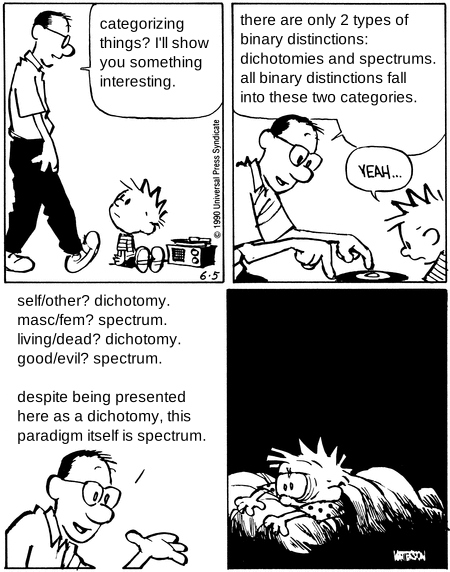
Just like the almost deifying uncompromising demand for efficiency, there sits within us a deep-seated desire for simplification. Complex ideas must be explained, flattened, torn to pieces, stripped of all but their most vital components, arranged into a logical chain, and wrapped together in a neat consumable package accessible to the everyman. This capacity for simplification is nearly infinite: a concept as complex as your sense of self can be reduced to just the id, ego and superego, and those 3 can be further called your inner child, adult and authority. An 800 page book can be easily summarized in a 16 minute video.6 You can make a Calvin and Hobbes meme out of everything.
Luckily, some philosophers in the 1980s have come up with an alternative the logic — rhizomes. Unlike a logical chain (or tree), which has a strictly defined (partial) order, each statement depending on the ones that came before, a rhizome is like the unordered vertex set of a graph.
If a logical chain has steps A, B and C, the rhizome of the same concept would instead consider A-B-C all at once, as a molecule. Rhizomes have been staring you in the face your entire life, like a corkboard with red string, but fractal, having lost all sense of time.
Certain themes common in media that you were too young to understand, together slowly form a picture. The signal cannot be understood until nearly all of it has been transmitted.7 Like transmitting a picture one pixel at a time, it's better to do so in a random order.2
When you see a Chekhov's gun, you see it in its entirety. The gun is simultaneously shown to you in act 1, identified as a Chekhov's gun, and in the same moment fired in act 3. Time is a bread loaf already baked.8 No single action makes sense in isolation. Lines of plot chain together and loop back on themselves, almost impossible to follow, unless you consider the whole thing at once.3 The story becomes its Ultimate Self.9 Everything, Everywhere, All at Once.
When talking about a compiler or an operating system, objects of great complexity, computer science professors use the parable about an elephant.10 Depending on which part of an operating system you're touching, it can look like a context switcher, standard library, or gui framework. All of these things make up an operating system, but none are really the root nature. So, with which of them do you start your explanation?
Logical explanations often imply causality. You start with a root cause, a one sentence definition, some distilled sense of true essence, and go on from there. But some things are hard to define like this. So you must just start using them. Let the reader rediscover the word organically, as if they're a child learning to speak for the first time. Say not what it is, but what it is not, and what it can be.
Rhizomes are everywhere. They are fractal. They are you and me, the world and the internet. They are also a rhizome themselves. But that should be obvious by now.